Residents of Addis Ababa have a pragmatic, no frills attitude about toilets. In Western culture, bathrooms range from the merely functional to extreme escape spa havens, but in much of Addis, bathrooms and toilets exist for only the most basic and necessary functions.
Those contained in houses or public buildings are often pretty dismal and it’s also not unusual to see someone squatting without fuss to discharge bodily waste on a hillside, in an empty lot, or by the side of the road. Having used some of the city’s inside plumbing, I can hardly blame them for opting for a natural setting instead.
A friend and I, both of us desperate to pee after an evening concert at the Emperor’s old Palace, finally located a rank old potty tucked into a dark wet corner underneath a wide marble staircase at the back of the palace. Holding our breath against the smell, we took turns trying to find and then perch upon the one tiny patch of dry floor while taking care of business (not an easy task after a few glasses of wine. I offered her the option to go first, partly to see if she survived.)
Upstairs, the spacious royal bathrooms upstairs are much nicer ~ his and hers studies in vintage European 1930s or 40s decor, one blue, one pinkish. But, unfortunately, not for public use.
Newer hotels and restaurants in Addis are catching on, however. The bathroom in my room at the Faro Boutique Hotel, for example, was modern and very clean. But construction on my floor of the hotel wasn’t quite finished when I stayed there, however, so I may have been the first to actually use it.
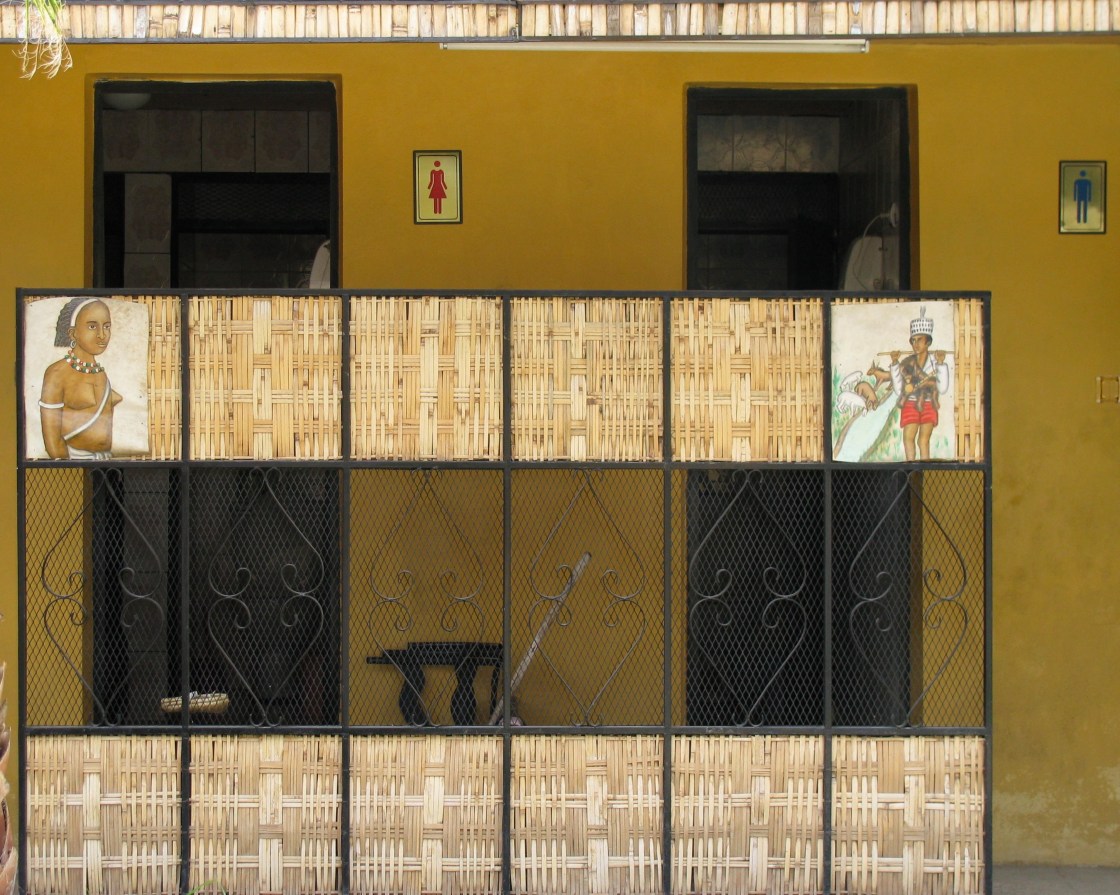
Another loo, at a restaurant outside the National Museum (note the use of native art to help you decide which door to enter) was also fine – although there was no running water to wash up with the day I was there. A waiter or waitress, depending upon which side you chose, stood by patiently with a pitcher of water to pour over your hands once you’d finished soaping them.
And then there is the Boston Day Spa ~ a clean and calming refuge from the streets of Addis. With its colorful inlaid mosaics, soft lighting, gentle music, aromatherapy, and happy staff, you might actually want to move in. The Boston Day Spa is the creation of Tadiwos Belete, an Ethiopian refugee who fled his country in 1974 when communists overthrew Emperor Haile Selassie. Just 17 years old at the time, Tadiwos emigrated to America. He landed in Boston where he pursued his interest in hairstyling, taking classes at a community college. Twenty-three years later, with two posh salons, including one on trendy Newberry Street, Tadiwos had nailed the American dream.
In 2000, heeding his country’s call to its diaspora, Tadiwos sold his salons and returned to East Africa, wanted to be part of the new, emerging Ethiopia. Shortly after, he opened the Boston Day Spa in the Bole neighborhood of Addis Ababa. “Ethiopia needs its own people to come back with a vision and create a new style of business in areas that have not been developed before,” Tadiwos explained. Just one of several ventures Tadiwos has now brought into being in Ethiopia, the Boston Day Spa combine western-style services with a unique Ethio chic. And at Ethiopian prices, a pedicure with a dream-inducing, hour-long massage sent me back just $27.
© Kristin Fellows 2011
 Kristin Fellows